.png?x-oss-process=image/resize,w_200/quality,q_100)
Do you know the advantages and disadvantages of horizontal directional drilling rig?
Do you know the advantages and disadvantages of horizontal directional drilling rig?
Jul 18, 2022
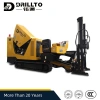
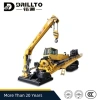
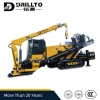
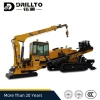
Horizontal directional drilling rig is a kind of construction machinery for laying a variety of underground utilities (pipelines, cables, etc.) without excavating the ground surface. It is widely used in the laying and construction of water supply, power, telecommunications, natural gas, gas, oil and other pipelines. It is suitable for sand, clay, pebbles and other ground conditions. It can be constructed in most non hard rock areas in China. The working environment temperature is -15 ℃ ~+45 ℃. Horizontal directional drilling technology is a new construction technology that combines the directional drilling technology of the petroleum industry with the traditional pipeline construction method. It has the advantages of fast construction speed, high construction accuracy and low cost. It is widely used in the pipeline laying construction projects of water supply, gas, electricity, telecommunications, natural gas, oil and so on. Horizontal directional drilling equipment has also achieved rapid development in more than a decade, and has become an emerging industry in developed countries. At present, its development trend is towards large-scale and miniaturization, adapting to hard rock operation, self-contained anchoring system, automatic stacking and extraction of drill pipes, automatic lubrication of drill pipe connection, anti electric shock system and other automatic operation functions, ultra deep guidance monitoring, wide application range and other characteristics.
So what are its advantages and disadvantages? Now let's learn about:
(1) Advantages of horizontal directional drilling
1. When directional drilling is used for crossing construction, the above ground function can be used normally. For example, when crossing roads and railways, the traffic may not be blocked; When crossing the river, it can ensure that the river is unblocked without blocking navigation and flood drainage.
2. Due to the non excavation construction, the excavation, transportation and stacking of a large amount of engineering soil are reduced, which is conducive to environmental protection. At the same time, it also correspondingly reduces the cost of foundation embedding and ground restoration.
3. Short construction period, rapid operation, low comprehensive cost and significant social benefits. When the excavation construction cannot be carried out or is not allowed, the directional drill can be used to cross under it. Today, with the rapid development of urban construction, avoiding the road zipper project caused by repeated excavation and repair has high social and economic benefits.
(2) Disadvantages of horizontal directional drilling
1. As horizontal directional drilling is a new production technology, there is no unified technical standard and construction acceptance specification in China at present, resulting in no official basis for the control of engineering design and construction quality. Once a quality accident occurs, it will also make it difficult to identify the responsible party.
2. Due to the use of directional reaming and dragging, the gap between the pipe and the back reamed hole shall be treated at the end of the construction, which cannot be backfilled and compacted like the slotted laying construction. Therefore, there are certain risks in the actual use of I-Pass with relatively high requirements for pipe settlement.
Recent Posts

Contact US
Product Information
Quantity
Unit
Piece
Support order samples, customization, wholesale direct, and complete payment. If the product you look for does not have corresponding customized content, pls fill out the form below to contact us, and we will reply ASAP.