.png?x-oss-process=image/resize,w_200/quality,q_100)
Host power system of Horizontal Directional Drilling Machine
Host power system of Horizontal Directional Drilling Machine
Nov 22, 2022
The host
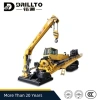
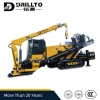
The power system of the main engine is generally a diesel engine. As a power source, the diesel engine is one of the indicators to measure the construction capability of the drilling rig. However, the drilling rig needs to run at a constant load during the pull-back process, so the continuous power of the engine is more important. In order to reduce labor intensity and improve labor efficiency, the main engine is generally equipped with an automatic loading and unloading device for drill pipes. When drilling, the drilling rig automatically removes the drill pipe from the drill pipe box and rotates it to the drill pipe column. When dragging back, just the opposite. Some are also equipped with an automatic lubricating oil application device, and the lubrication of the thread of the drill pipe joint helps to prolong the life of the drill pipe. The drilling rig should be completely fixed during work. If movement occurs during drilling and pulling, on the one hand, it may cause damage to the engine, on the other hand, it will reduce the push-pull force, resulting in power loss in the hole. At present, the drilling rig has an automatic hydraulic anchoring system, and the anchor rod is drilled into the soil layer by its own power. Generally, a straight anchor rod is used in a dry soil layer, and a spiral anchor rod is used in a wet soil layer.
Drilling tool
The drill pipe should have sufficient strength to avoid twisting and breaking, and should be flexible enough to drill curved channels. In long-distance traversing, the length of the drill pipe directly affects the drilling efficiency, especially when wire guidance is used, the long drill pipe reduces the number of drill pipe connections, which will significantly save the connection time. The change of the drilling direction is achieved by controlling the direction of the drill bit.
The drill bit is generally wedge-shaped. During the forward process, if the drill bit rotates continuously, the drilling trajectory is a straight line. When the drill bit wants to go around obstacles or move forward with a certain radius of curvature, the drill bit stops rotating, and the wedge surface stays at a certain angle before advancing. In this way, the drill bit advances in the direction opposite to the wedge face. The swash plate of the drill bit usually has nozzles, and high-speed mud is sprayed out from the nozzles to scour the soil layer. Gas and heat should use different drill bits for different soil layers. For example, in soft clay, a larger drill bit is generally used to facilitate direction change during the advancing process. In harder calcareous layers, use smaller drill bits. In hard rock drilling, special drill bits should be selected, such as small-sized cemented carbide drill bits with inlaid welding.
There are many types of reamers, and different reamers are suitable for different soil layers. For example, the groove reamer is suitable for sandy land and tight sandy land containing rocks, but it is easy to become spherical when running in high-viscosity clay; the rod-shaped cutter is suitable for hard soil layers and clay layers, but cannot be used in rocky ground. or run efficiently on pebbles.
Recent Posts

Contact US
Product Information
Quantity
Unit
Piece
Support order samples, customization, wholesale direct, and complete payment. If the product you look for does not have corresponding customized content, pls fill out the form below to contact us, and we will reply ASAP.