.png?x-oss-process=image/resize,w_200/quality,q_100)
Basic structure of horizontal directional drilling
Basic structure of horizontal directional drilling
May 10, 2023
(1) Host
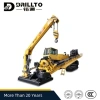
The power system of the main engine is generally a diesel engine. Diesel engine is used as a power source, and its power is one of the indicators to measure the construction ability of the drilling rig. However, the drilling rig needs to operate with a stable load during the back-towing process of the drilling rig, so the continuous power of the engine is more important. In order to reduce labor intensity and improve labor efficiency, the main engine is generally equipped with automatic loading and unloading equipment for drill pipes. When drilling, the drilling rig actively removes the drill pipe from the drill pipe box and rotates it to the drill pipe column. When dragging back, just the opposite. Some are also equipped with lubricating oil automatic coating equipment, and the lubrication of the thread of the drill pipe joint helps to extend the life of the drill pipe. The drilling rig should be completely fixed during work. If movement occurs during drilling and pulling, on the one hand, it may cause damage to the engine, on the other hand, it will reduce the push-pull force, resulting in power loss in the hole. Now the new drilling rigs have an active hydraulic anchoring system, relying on their own power to drill the anchor into the soil layer, generally use a straight anchor rod in the dry soil layer, and use a spiral anchor rod in the wet soil layer.
(2) Drilling tools
The drill pipe should have sufficient strength to prevent twisting and breaking, and it must be flexible enough to drill curved channels. In long-distance traversing, the length of the drill pipe directly affects the drilling power, especially when wire guidance is used, the long drill pipe reduces the number of drill pipe connections, which will significantly save connection time. The change of the drilling direction is achieved by manipulating the direction of the drill bit.
The drill bit is generally wedge-shaped. During the forward process, if the drill bit continues to rotate, the drilling trajectory will be a straight line. When the drill bit wants to go around obstacles or move forward with a certain radius of curvature, the drill bit stops rotating, and the wedge surface stays at a certain angle before pushing. In this way, the drill bit advances in the direction opposite to the wedge face. The swash plate of the drill bit generally has nozzles, and high-speed mud is sprayed out from the nozzles to scour the soil layer. Gas and heat should use different drill bits for different soil layers. For example, in soft clay, a larger-scale drill bit is generally used to facilitate changing the direction during the pushing process. In harder calcareous layers, use smaller drill bits. In hard rock drilling, special drill bits should be selected, such as small-scale cemented carbide drill bits with inlaid welding.
There are many types of reamers, and different reamers are suitable for different soil layers. For example, the groove-shaped reamer is suitable for sandy land and tight sandy land containing rocks, but it is easy to become spherical when operating in high-viscosity clay; the rod-shaped cutter is suitable for hard soil layers and clay layers, but cannot be used in rocky ground Or pebbles run effectively.
(3) Guide system
Guidance systems include wireless guidance systems and wired guidance systems. The wireless guidance system consists of a hand-held surface detector and a probe installed in a drill bit. The detector judges the depth of the drill bit, wedge inclination and other parameters by receiving the electromagnetic wave signal emitted by the probe, and simultaneously transmits the signal to the display on the console of the drilling rig, so that the driller can adjust the drilling parameters in time to control the drilling. When crossing rivers and lakes, because the ground is difficult to walk or the drilling depth is too deep, it is difficult to receive electromagnetic wave signals, so a wired guidance system must be used. After the probe passes through the drill pipe, it is connected with a cable to transmit the signal to the console. Because the cables have to be manually connected through the drill pipe one by one, the use of the wired guide will consume a considerable amount of time.
(4) Mud system
The mud system is an important equipment for the smooth progress of reaming and pipe pullback. After the bentonite, water and additives are fully mixed in the mud tank, they are pressurized by the mud pump and sprayed out from the nozzle of the drilling tool through the drill pipe to scour the soil layer and take away the cuttings to assist drilling. Drilling mud can cool downhole drilling tools and avoid overheating and wear of drilling tools. Another important effect of drilling mud is to reduce the friction between the pipe wall and the hole wall when pulling back the pipe. In an ideal state, the pipeline is suspended in the mud and pulled out, so in actual engineering, if the drilling is well formed, the required pulling force for the pipeline is often much smaller than expected. The horizontal directional drilling pipe hole diameter is generally relatively large, and the stability of the hole wall is poor. However, after the drilling mud condenses, it can stabilize the hole wall.
(5) Intelligent assistance system
The intelligent auxiliary system of drilling rigs has developed rapidly in recent years. After pre-inputting parameters such as the orientation of underground pipelines and obstacles, the type of drill pipe, the drilling depth, the orientation of the inlet and outlet, and the allowable bending radius of the pipeline, the drilling planning software can automatically design an ideal path, including the entry angle, exit angle, The specific orientation of each drill pipe can be adjusted according to the actual situation in actual engineering.
Recent Posts

Contact US
Product Information
Quantity
Unit
Piece
Support order samples, customization, wholesale direct, and complete payment. If the product you look for does not have corresponding customized content, pls fill out the form below to contact us, and we will reply ASAP.